
The Pulse of Spice and Sound Inside Marrakech’s Living Market Maze
Exploring the Colors, Flavors, and Traditions That Shape the Culinary Heart of Morocco’s Most Enchanting City
The Soul of the Souk
To walk through the street markets of Marrakech is to step into a living symphony of senses. The medina, the walled heart of the city, beats with rhythms that have pulsed for centuries. Narrow alleys twist between stalls draped in textiles, baskets, and brass lanterns, while the air vibrates with the hum of bargaining voices and the scent of simmering tagines. These souks, as they are known, are not simply places of commerce but spaces of culture, where stories, recipes, and traditions pass as easily as coins. Every aroma, every call to prayer in the distance, and every splash of saffron-colored fabric tells the story of a city that lives through its markets.
Marrakech’s souks evolved as crossroads of trade and exchange. Situated between the Atlas Mountains and the Sahara, the city became a vital point on ancient caravan routes that connected Sub-Saharan Africa with the Mediterranean. Traders arrived with camels laden with salt, gold, leather, and spices, transforming Marrakech into a vibrant mosaic of cultures. The markets today remain faithful to that legacy. Though electricity has replaced oil lamps and tourists mingle with locals, the essence of barter, hospitality, and craftsmanship endures. To experience these markets is to encounter the city’s soul, unfiltered and alive.
The Labyrinth of Flavors
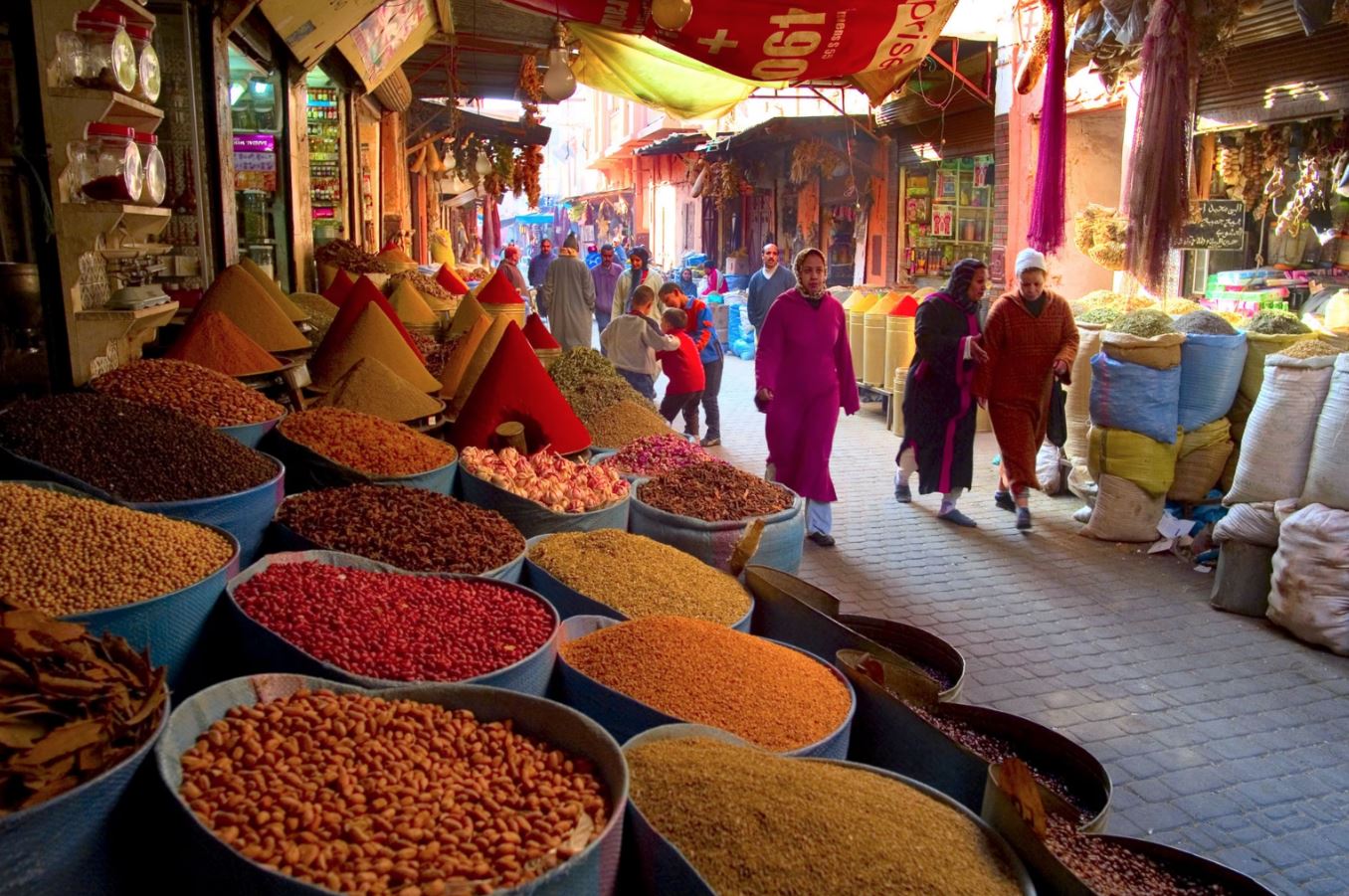
Among the twisting lanes, the spice stalls stand as the beating heart of culinary Marrakech. Their shelves rise like dunes of color, filled with mountains of paprika, turmeric, cumin, cinnamon, and saffron. The air is heavy with fragrance, at once earthy and sweet. Vendors scoop the powders with practiced grace, wrapping them in paper cones as if they were treasures. Spices are more than ingredients here, they are the language of Moroccan cooking, shaping every meal from the humble couscous to the royal pastilla. Each blend tells a story of geography and tradition, of flavors carried by caravans and blended through generations.
Food in Marrakech is built upon the harmony of these spices. Cumin lends warmth, coriander adds brightness, and preserved lemon brings balance. Stalls sell ras el hanout, the legendary spice mix whose name translates to “head of the shop.” Each merchant guards his own recipe, a blend of up to thirty ingredients that might include rose petals, nutmeg, ginger, and cardamom. The complexity mirrors the city itself, a fusion of Berber, Arab, Andalusian, and African influences. As visitors pass through the narrow passages, they do not just smell food, they inhale history, a lineage of trade and taste that still defines Moroccan identity.
The Market of Senses and Stories
As the day unfolds, the market transforms with light and sound. Early morning brings a calm hum as merchants open their doors and sweep the dust from the cobblestones. By midday, the alleys fill with chatter, and the scent of grilled meats drifts through the heat. By evening, the markets glow beneath strings of lamps, each stall illuminated like a jewel in a mosaic of light. The medina becomes a theater of life, where locals shop for daily goods while travelers lose themselves in discovery. What makes these markets unique is not only what they sell but how they are lived. Every purchase involves conversation, laughter, and hospitality, a ritual exchange that embodies the spirit of Moroccan culture.
In Jemaa el-Fnaa, the great square at the edge of the medina, this sensory intensity reaches its peak. The square is a shifting tapestry of performers, storytellers, musicians, and cooks. Smoke rises from grills as snake charmers weave melodies through their flutes. Brass teapots clink as mint tea is poured from great heights into delicate glasses. Stalls appear and disappear like mirages, offering skewers of lamb, bowls of harira soup, and fresh-squeezed orange juice. It is chaos and harmony in equal measure. Every night in Jemaa el-Fnaa is both ancient and new, a reflection of a city that refuses to let tradition fade into silence.
The Craftsmanship of Taste
Beyond the spices and sizzling dishes, the markets of Marrakech also house the tools of Moroccan cuisine. Copper pots gleam in rows, hammered by hand in workshops hidden behind narrow doors. Ceramic tajines, their conical lids painted with geometric patterns, are stacked in pyramids that catch the sunlight. Wooden spoons carved from olive wood, baskets woven from palm leaves, and knives forged in centuries-old workshops fill the souks with the artistry of daily life. Each object embodies the craft and patience of its maker, a tradition of skill passed down through families.
These tools are not mere souvenirs but living artifacts that shape the rhythm of Moroccan kitchens. The tajine, for example, is both pot and philosophy. It symbolizes slow cooking, communal eating, and respect for time. In the markets, one can watch artisans at work, their hands steady and purposeful. The clang of hammer on metal, the swirl of pigment on clay, all create a soundtrack as vital as any song. The market is an ecosystem of creation where food, art, and craftsmanship coexist. To shop here is to witness the making of both objects and memories, each purchase echoing the values of patience and pride.
The Street Food Journey
When evening falls, the market becomes a feast without walls. Lanterns glow over stalls that sizzle with life, and the air fills with aromas of grilled fish, roasted lamb, and freshly baked khobz bread. Vendors call out with enthusiasm, inviting passersby to taste their specialties. One might begin with snail soup, served steaming in small bowls infused with herbs. Next come skewers of merguez sausage, spicy and tender, followed by msemen, a buttery flatbread folded and fried until crisp. For dessert, warm honey pastries glisten beneath the lights, their sweetness balanced by a final glass of mint tea.
Street food in Marrakech is more than convenience, it is a cultural expression. Each stall reflects regional influence and family heritage. Recipes are often inherited rather than written, refined through repetition and care. The act of sharing food in the open air connects strangers through taste and conversation. Around communal tables, locals and travelers alike gather, united by curiosity and appetite. Every meal tells a story, every bite a memory. The vibrancy of Marrakech’s cuisine lies not in complexity but in its sincerity. It celebrates the raw beauty of ingredients, cooked with fire, faith, and feeling.
The Rhythm of Trade and Tradition
At the heart of Marrakech’s markets lies an unbroken chain between past and present. The structure of the souks remains rooted in ancient design. Each section specializes in a craft or commodity: one for leather, another for spices, another for metals. This organization reflects medieval guild systems, where mastery required years of apprenticeship. Even today, these divisions endure, preserving the integrity of trades that have shaped the city’s identity for generations. Leather tanners work in courtyards filled with vats of color, dyers hang textiles like rainbows across rooftops, and blacksmiths forge tools beside flickering fires.
Such continuity is not accidental, it is cultural resilience. Marrakech honors its traditions not through nostalgia but through living practice. Apprentices learn by observing masters, absorbing both skill and philosophy. To craft or cook in Marrakech is to participate in an unspoken heritage. The markets themselves act as living museums, yet they remain dynamic, constantly adapting. Plastic has joined palm fiber, and digital scales rest beside ancient brass weights. Still, the essence of the market remains untouched: a shared rhythm of exchange that binds people to their work and to one another.
Colors of Culture and Community
The visual splendor of Marrakech’s markets rivals its flavors. Each stall is an explosion of color, texture, and light. Spices form gradients from deep crimson to golden ochre. Textiles shimmer with threads of silver and indigo. Baskets overflow with olives in shades of green and purple. The markets engage every sense, creating an immersive environment that feels almost cinematic. Yet beneath this sensory abundance lies the quiet structure of community. Every vendor knows their neighbors. Families have occupied the same stalls for decades, cultivating trust that sustains both commerce and kinship.
Visitors are not mere spectators here. They are invited to participate, to taste, touch, and learn. Bargaining becomes conversation, a playful dance that builds connection rather than competition. Locals take pride in their craft and hospitality, offering tea as often as they offer goods. This warmth extends beyond transaction. It reflects the Moroccan concept of “baraka,” a sense of blessing that infuses generosity with spiritual meaning. In Marrakech’s markets, the exchange of money becomes secondary to the exchange of energy, respect, and curiosity. It is this invisible currency that gives the souks their enduring vitality.
The Eternal Market of the Human Spirit
As dawn gives way to dusk and the sounds of the call to prayer echo through the medina, Marrakech’s markets continue their eternal rhythm. They are more than physical spaces, they are living reflections of human persistence and joy. Each scent of cumin, each clang of copper, and each shared smile is part of a larger story written over centuries. To wander these markets is to witness the essence of culinary culture in motion, where food, craft, and community weave together in endless conversation. The markets of Marrakech remind us that cooking begins not in the kitchen but in the streets, where flame, spice, and humanity meet. Here, amid the labyrinth of alleys and aromas, the city’s heart beats strongest, carrying the spirit of Morocco forward, one meal, one memory, and one story at a time.